How Insurance Leads Actually Work (And Why Most Agents Overpay)
If you're an insurance agent, there's a good chance you've bought leads before. And there's an equally good chance you felt burned by the experience.
You pay $20 to $100 per lead. You call immediately. The consumer has already talked to five other agents. The phone number is disconnected. The email bounces. Or they answer and say, "I already bought a policy yesterday."
Sound familiar?
The problem isn't that insurance leads are inherently bad. The problem is that the way they're generated, packaged, and sold is fundamentally designed to benefit the platform, not you. Understanding how the machine works is the first step toward spending your money smarter and building a pipeline that actually converts.
How Insurance Lead Generation Actually Works
Most lead generation platforms follow the same basic model. It's simple, scalable, and extremely profitable — for them.
Here's the playbook:
-
The platform runs ads — Google, Facebook, programmatic display, sometimes even TV or radio. These ads promise consumers "free quotes in 60 seconds" or "compare rates from top insurers instantly."
-
A consumer fills out a form — They enter their name, phone number, email, zip code, and basic coverage details. They think they're getting a quote. They're actually becoming a lead.
-
The platform sells that lead to multiple agents — This is called multi-sell distribution (sometimes called "shared leads"). One consumer form submission gets sold to anywhere from 5 to 10 different agents simultaneously.
-
Agents race to call first — Because every agent on that lead knows they're competing, the game becomes about speed. Whoever dials fastest has the best shot.
That's it. That's the entire model.
The platform's job is to generate form fills at scale. Your job is to somehow convert a stranger who's already being called by a half-dozen other agents. The platform gets paid regardless of whether anyone closes.
Why Insurance Leads Feel "Burned Out"
When you buy a shared lead, you're entering a race you're designed to lose most of the time. Here's why those leads feel dead on arrival:
The consumer is overwhelmed. Within minutes of submitting a form, they receive 5 to 15 phone calls. Their inbox fills up. Their phone buzzes nonstop. By the time you reach them, they're annoyed, defensive, and just want the calls to stop.
They've already received multiple quotes. The fastest agents quoted within minutes. If you're calling an hour later, you're presenting options they've already heard. You're not bringing value — you're adding noise.
Price becomes the only differentiator. When 8 agents are quoting the same consumer, there's almost no way to compete on service, expertise, or relationship. It turns into a race to the bottom on premium. The cheapest quote wins, regardless of coverage quality or agent competence.
Contact information decays fast. Some leads are recycled or aged. The phone number that was valid when the form was filled out might be disconnected by the time you call. Email addresses might be throwaway accounts the consumer used specifically to avoid spam.
This is why many agents report close rates of 5% or less on purchased leads. It's not because they're bad salespeople — it's because the system is stacked against them. If you're struggling with cold outreach in general, our guide on insurance cold call scripts can help sharpen your approach, but scripts alone won't fix a broken lead source.
The Real Cost of Insurance Leads
Most agents look at cost per lead and think that's the number that matters. It's not. What matters is cost per acquisition — how much you actually spend to close one customer.
Let's break it down:
| Metric | Typical Range |
|---|---|
| Cost per lead | $20 – $100 |
| Contact rate | 15% – 30% |
| Close rate (of contacted) | 10% – 20% |
| Effective close rate (of purchased) | 3% – 8% |
| Cost per acquisition | $250 – $2,000+ |
So if you're buying leads at $40 each and closing 5% of them, your cost per new client is $800. That's before you factor in:
- Your time — Every lead requires research, dialing, follow-ups, and quoting. Even the ones that go nowhere eat hours.
- Opportunity cost — Every hour spent chasing cold leads is an hour not spent on referral generation, cross-selling existing clients, or building your online presence.
- Tool costs — You need a solid CRM to manage lead follow-up workflows, adding another layer of expense.
- Emotional cost — Constant rejection is draining. Many agents burn out not because they lack skill but because the lead source sets them up for failure.
When you calculate the true, fully loaded cost of a shared lead, the economics often look terrible — especially for newer agents who don't have the cash flow to absorb a 95% loss rate.
Why This Model Still Exists
If shared leads are so bad, why do platforms keep selling them? Because the model is incredibly profitable — for the platform.
They sell the same lead multiple times. One form submission at a $5 cost-per-click turns into $200 to $500 in revenue when sold to 5 to 10 agents at $40 to $50 each. The margins are enormous.
They don't depend on conversion. The platform gets paid whether you close the lead or not. There's zero incentive to improve lead quality because their revenue is tied to volume, not outcomes.
Agents keep buying. Despite poor results, many agents feel they have no alternative. They need pipeline, and buying leads is the fastest way to get names and numbers in front of them. It's a treadmill — you hate it, but you're afraid to step off.
The consumer doesn't know better. Most consumers filling out "free quote" forms have no idea their data is about to be sold to a crowd of agents. If they did, most wouldn't submit the form.
This information asymmetry keeps the machine running. Consumers keep submitting forms. Agents keep buying leads. Platforms keep profiting from both sides.
Smarter Prospecting Strategies (That Don't Require Buying Leads)
Before we talk about the newest alternative, it's worth acknowledging that many of the most successful agents have reduced or eliminated their dependence on purchased leads entirely. Here's how:
Referrals. Still the highest-converting lead source in insurance. A warm introduction from an existing client converts at 40% to 60% — compared to 5% for a cold lead. If you haven't built a systematic referral program, start there. Our complete guide on how to get referrals as an insurance agent walks through the exact process.
LinkedIn prospecting. Particularly effective for commercial lines and high-net-worth personal lines. Building relationships on LinkedIn gives you access to decision-makers without paying per contact. Check out our guide on LinkedIn prospecting for insurance agents for a step-by-step approach.
Content and SEO. Publishing helpful content that ranks in search brings consumers to you already in research mode. They're not being sold — they're seeking information. This is the long game, but it compounds over time.
Community presence. Sponsoring local events, joining business groups, volunteering — all of these create visibility and trust that no paid lead can replicate.
These strategies take more effort upfront, but they produce leads that are warmer, cheaper, and more likely to become long-term clients.
The Smarter Alternative: Being Chosen Instead of Chasing
A newer model is emerging that sits between "buy cold leads" and "build everything from scratch." It's the agent marketplace.
The concept is straightforward: instead of agents buying consumer data, consumers browse agent profiles and choose who to contact. The dynamic flips entirely.
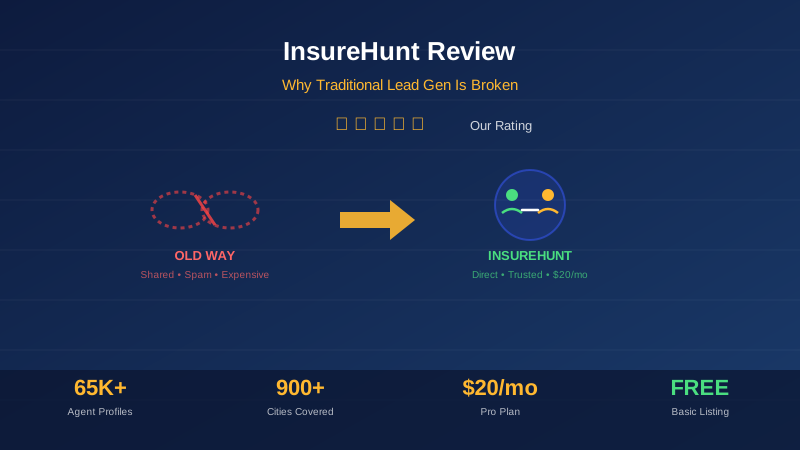
This is where platforms like InsureHunt come in. InsureHunt operates as a two-sided marketplace where:
- You build a profile — showcasing your expertise, insurance lines, service area, and reviews
- Consumers browse and compare agents — they search by location and insurance type, read reviews, and evaluate options
- They choose you — when a consumer reaches out, they've already decided you look like a good fit
The difference in conversation quality is dramatic. Instead of cold-calling a stranger who's fielding 10 other calls, you're having a warm conversation with someone who specifically selected you based on your profile and reputation.
No lead fees. No shared distribution. No race to the phone.
For a deeper look at how InsureHunt works and how to maximize your profile, read our full InsureHunt review.
How to Transition Away From Lead Dependency
You don't have to quit purchased leads cold turkey. But you should be working toward a diversified pipeline where paid leads represent a smaller and smaller share over time. Here's a realistic transition plan:
Month 1-3: Audit and baseline. Track your true cost per acquisition on purchased leads. Include your time, tools, and opportunity cost. Know your real numbers.
Month 3-6: Build alternative channels. Set up your InsureHunt profile. Launch a referral program. Start posting on LinkedIn. Begin creating content. None of these will replace leads overnight, but they all compound.
Month 6-12: Shift budget gradually. As alternative channels start producing, reduce your lead spend. Redirect that budget toward tools and activities that support inbound — better CRM workflows, review generation, content creation.
Month 12+: Lead independence. The goal isn't zero purchased leads necessarily — it's having enough diversified pipeline that you're never dependent on any single source, especially one with 95% waste rates.
Final Thoughts
Insurance leads aren't inherently bad. The information has value. The intent is real — someone did fill out a form looking for coverage.
But the distribution model is broken. Multi-sell leads create a terrible experience for consumers and a losing game for most agents. The platforms profit regardless of outcomes, and the incentives are fundamentally misaligned.
The agents who win long-term are the ones who:
- Reduce dependency on paid lead sources
- Invest in inbound channels — referrals, content, reputation, community
- Position themselves where customers come to them — through marketplaces, search, and word of mouth
- Track real metrics — cost per acquisition, not just cost per lead
The shift from "buying leads" to "being found" isn't just a strategy change. It's a fundamental rethinking of how you build your book of business.
Start by understanding the real cost of your current approach. Then start building alternatives. Your future self — and your bank account — will thank you.
Ready to stop chasing and start being chosen? Create your free profile on InsureHunt.com and see what it feels like when consumers come to you. And for the full breakdown of how the platform works, read our complete InsureHunt review.