Life & Health vs Property & Casualty: Which License Should You Get First?
If you are preparing to enter the insurance industry, one of your earliest decisions is which license to pursue first: Life & Health (L&H) or Property & Casualty (P&C). Both open the door to a legitimate, high-earning career. But they lead to very different day-to-day experiences, client relationships, income patterns, and long-term career paths. This guide compares the two so you can make an informed choice based on your goals, not guesswork.
What Each License Covers
Life & Health (L&H)
A Life & Health license authorizes you to sell products that protect people and their families from financial loss related to death, illness, and disability. The major product categories include:
- Term life insurance -- Affordable coverage for a set period (10, 20, or 30 years)
- Whole life insurance -- Permanent coverage with a cash value component
- Universal life insurance -- Flexible permanent coverage with adjustable premiums
- Annuities -- Retirement income products that guarantee periodic payments
- Health insurance -- Medical, dental, and vision coverage for individuals and groups
- Disability insurance -- Income replacement if a client cannot work due to illness or injury
- Long-term care insurance -- Coverage for nursing homes, assisted living, and home health care
- Medicare supplements and Medicare Advantage plans -- Coverage for the senior market
Property & Casualty (P&C)
A Property & Casualty license authorizes you to sell products that protect physical assets and shield people and businesses from liability. The major product categories include:
- Auto insurance -- Personal and commercial vehicle coverage
- Homeowners insurance -- Protection for homes and personal property
- Renters insurance -- Coverage for tenants' belongings and liability
- Commercial property insurance -- Protection for business buildings, inventory, and equipment
- General liability insurance -- Coverage for businesses against third-party injury or property damage claims
- Workers compensation -- Coverage for employee injuries on the job
- Commercial auto -- Fleet and business vehicle coverage
- Umbrella policies -- Excess liability coverage beyond primary policy limits
- Professional liability (E&O) -- Protection against malpractice and negligence claims
Exam Difficulty: How They Compare
Both exams are challenging, but they test different knowledge sets and thinking styles.
The P&C Exam
The P&C exam is widely considered the more difficult of the two. Here is why:
- Broader content scope. You need to understand dozens of policy types across personal, commercial, and specialty lines
- More numerical concepts. Rating factors, coinsurance penalties, deductible calculations, and coverage limits require comfort with math
- Dense terminology. Terms like subrogation, indemnification, additional insured, and named perils versus open perils can trip up candidates
- State-specific regulations. P&C has extensive state-level rules around auto insurance, homeowners requirements, and surplus lines
Most states require 40 to 80 hours of pre-licensing education for P&C. First-time pass rates typically hover around 55% to 65%, though candidates who use quality study materials and practice exams regularly pass at higher rates.
The L&H Exam
The L&H exam covers fewer product categories but goes deeper into policy mechanics and financial concepts:
- Narrower but deeper content. You will study fewer policy types but need to understand them thoroughly, including cash value accumulation, policy loans, settlement options, and tax treatment
- Conceptual focus. L&H exams lean more on understanding concepts like insurable interest, needs analysis, and suitability rather than memorizing coverage forms
- Less math overall. While annuity calculations and premium modes appear, the math is generally simpler than P&C rating
- Regulation emphasis. Heavy focus on replacement regulations, disclosure requirements, and ethical selling practices
Most states require 40 to 60 hours of pre-licensing education for L&H. First-time pass rates tend to be slightly higher than P&C, typically in the 60% to 70% range.
Bottom line on difficulty: If math and memorization are your strengths, P&C may come more naturally. If you prefer conceptual thinking and relationship-based advising, L&H may feel more intuitive.
Income Potential: L&H vs P&C
The income profiles for these two paths differ significantly in both structure and timeline.
P&C Income Profile
P&C agents tend to build steady, predictable income over time. The key characteristics are:
- Smaller individual commissions but high volume opportunity
- Strong renewal income. P&C policies renew annually, and retention rates run 85% to 92% in personal lines
- Consistent cash flow. Once your book reaches critical mass, monthly income becomes predictable
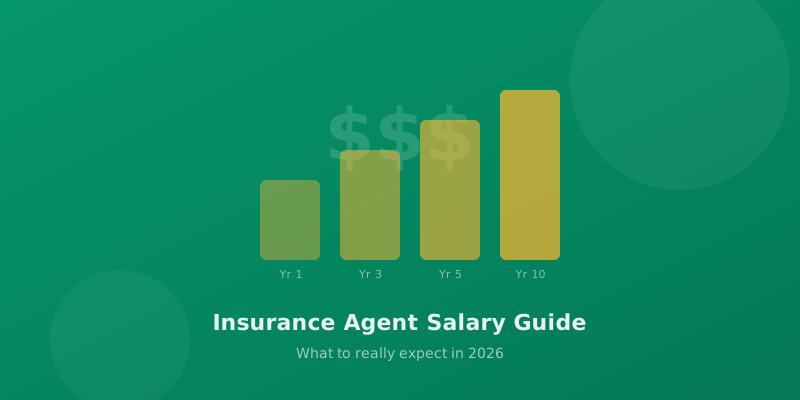
- Typical year-one income: $30,000 to $50,000 (captive with base) or $25,000 to $40,000 (independent)
- Typical year-five income: $65,000 to $120,000 depending on book size and specialization
P&C income is like building a dividend portfolio. Each policy is a small asset that pays you year after year. The compounding effect of renewals means your income floor rises steadily even during slower sales months.
L&H Income Profile
Life & Health agents can earn large upfront commissions but face more income volatility:
- Large first-year commissions on life products, often 50% to 110% of the annual premium
- Lower renewal commissions compared to the initial sale
- Feast-or-famine cycles. A great sales month can be followed by a dry spell
- Higher per-sale earnings. A single whole life policy can generate $2,000 to $15,000 in commission
- Typical year-one income: $25,000 to $55,000 with significant variance
- Typical year-five income: $60,000 to $140,000 for consistent producers
L&H income rewards strong closers who can handle consultative, longer sales cycles. The senior market (Medicare and final expense) offers more transactional sales with quicker closes but lower per-policy commissions.
Which Pays More?
Neither license inherently pays more. What matters is your sales ability, consistency, and chosen niche. However, agents who hold both licenses and cross-sell across product lines consistently outearn single-license agents by a significant margin.
Which Is Easier to Start With?
Several factors make P&C the more common starting point for new agents:
P&C is easier to prospect. Everyone needs auto and home insurance. These are mandatory or expected purchases, which means you are not convincing people they need the product, just that they should buy it from you. Life insurance is a harder conversation because people do not like thinking about death, and there is no legal requirement to carry it.
P&C has a faster sales cycle. A personal auto or home quote takes minutes. A life insurance needs analysis can take weeks from first meeting to issued policy.
P&C clients come to you. People actively shop for P&C insurance when they buy a house, a car, or start a business. Life insurance prospects rarely seek out an agent on their own.
P&C provides more touchpoints. Annual renewals, coverage reviews, and claims create natural reasons to stay in contact with clients. This builds relationships that lead to referrals and cross-selling opportunities.
That said, L&H can be the better starting point in certain situations:
- You have a strong existing network of young families, business owners, or high-income professionals who need life insurance
- You are drawn to financial planning and want to build a practice around retirement and estate planning
- You want to focus on the senior market selling Medicare, final expense, or long-term care products
- You prefer fewer, larger sales over high-volume transactional work
Market Demand in 2026
Both license types are in strong demand, but for different reasons.
P&C demand drivers:
- Rising property values and natural disaster frequency are pushing premiums higher, which means higher commissions per policy
- Hard market conditions in homeowners and commercial lines mean clients need more guidance navigating coverage changes
- Small business formation remains strong, creating steady demand for commercial P&C agents
L&H demand drivers:
- An aging population is driving massive demand for Medicare, long-term care, and final expense products
- The coverage gap in life insurance remains enormous, with industry studies showing that most American households are significantly underinsured
- Employer-sponsored benefits are increasingly complex, creating demand for group health and voluntary benefits specialists
- Financial literacy is increasing, leading more consumers to seek retirement planning advice that includes annuity products
Career Paths: Where Each License Leads
P&C Career Paths
- Personal lines agent -- Focused on auto, home, and umbrella for individual clients
- Commercial lines agent -- Focused on business insurance, often with higher earning potential
- Agency owner -- Building and managing a P&C agency with multiple producers
- Wholesale broker -- Placing specialty or hard-to-write risks with surplus lines carriers
- Underwriter or claims adjuster -- Moving to the carrier side with your product knowledge
L&H Career Paths
- Life insurance specialist -- Focused on term, whole life, and estate planning
- Medicare and senior market agent -- Serving the growing 65-plus population
- Financial advisor -- Adding securities licenses to offer comprehensive financial planning
- Group benefits consultant -- Selling health and voluntary benefits to employers
- Insurance marketing organization (IMO) leader -- Recruiting and training L&H agents
The Recommendation: Start Based on Your Strengths
There is no universally correct answer, but here is a practical framework:
Start with P&C if:
- You want steady, predictable income growth
- You prefer shorter sales cycles and higher volume
- You plan to work for a captive agency initially
- You like working with tangible products people already know they need
- You want to build a renewal book that generates income while you sleep
Start with L&H if:
- You are comfortable with consultative, relationship-based selling
- You have a strong natural market or network to tap into immediately
- You want the potential for large individual commissions
- You are interested in financial planning and retirement topics
- You plan to focus on the senior market
The best long-term move: Get both licenses. Many successful agents start with one and add the other within their first 6 to 12 months. Dual-licensed agents can serve clients comprehensively, cross-sell effectively, and build a more resilient income stream. If you are serious about a long career in insurance, plan to hold both an L&H and P&C license within your first year.
Whichever license you choose first, commit to mastering the products and sales process before adding the second. Spreading yourself too thin too early is a common mistake that slows progress on both fronts. Pick one, get licensed, build your foundation, and expand from there.